Friday, 28 October 2011

KEEPING AN EYE ON THINGS


Just for once, a wee personal blog to thank everyone for understanding and patience when I suddenly went as blind as a bloody bat a couple of months ago.

My first cataract surgery (a doddle) went A-1 this week and now I have one eye (almost) back on the job. Its twin will join the team during the first week of December. Right now, the two Celtic green orbs are at war and I see double after more than ten minutes or so in front of a screen. Please bear with me a tiny while longer.

Meantime, authors especially, don’t blame your individual BeWrite Books editor or Tony on tech and design for delays. They’re as on-the-ball as ever. Hold ups are all my fault because I must take a close look at all, post-edit, author-editor corrected manuscripts as the supposed ‘fresh eye’ before we go to print and ebook-live. Surprising what such a third eye – detached from the initial and often extended editorial process – can spot and correct in the nick of time.

And for a couple of months now that eye's been on wildcat strike.

Promised pre-Christmas releases will be produced. Cross my eyes, they will.

What sets BeWrite Books above even the Big Six – let alone the self-publisher – is attention to fine detail. I don’t need to ask those authors we work with whether they’d prefer a slight delay in publication to slap-dash results. We don’t have slap-dash authors. They scream their preference from the rooftops ... quality -- title by quality title. Manuscripts can be in nit-picking edit for a year or more. BeWrite Books does not do slap-dash.

All on the BeWrite Books team agreed that my temporary blindness would not threaten that ethic. As a minnow in a sea of shark- mediocre- and trash-infested slush, it's our saving grace. You'll never know how much I need to thank Tony, Hugh and Sam for making the decision to hold rather than rush and risk flaws.

Just for fun, let me tell you about this rare galloping cataract hitch I suddenly encountered. It really does have its up-side.

I can identify to the very night when I first realised something was wrong. A full moon had just risen and was flashing its signal across the Mediterranean Sea to my wee terrace a couple of hundred yards above. But I didn’t see the usual dappled grey dish ... I saw a ‘moonburst’ – a pyrotechnic display of exploding silver lights, enhanced by haloes of vividly coloured rings.

Sure that this was a unique cosmic event, I called out Skovia and roused all the neighbours. They saw nothing unusual. Even with binoculars and the special glasses we'd saved from the last solar eclipse.

From there in, things got even more psychedelic.

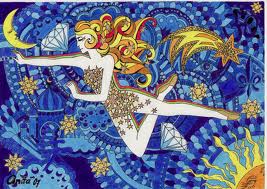
As my sight quickly faded, day by day and, noticeably, hour by hour, lights became my world. Wonderful lights. The glint from a wine glass, a candle flame, a sparkle from Skovia’s bracelet or engagement ring; all became starbursts of fabulous colour. I couldn’t see the glass, the candle or Skovia. I only saw the shining of them. What a thrill!

For the first time, I doubted John Lennon’s claim that his Lucy in the Sky with Diamonds title was an innocent coincidence and that the song’s initials didn’t imply that marmalade skies and kaleidoscope eyes were the result of a tab of acid that tends to dilate the pupils and cause visual hallucination. Skovia had kaleidoscope eyes and I saw marmalade skies -- and I don't do drugs heavier than a decent Highland malt or pure Virginia tobacco in my meerschaum pipes. Maybe with a dash of Perique from St James' Parish where it's exclusively grown.

I traveled in early morning darkness to surgery this week. The long, long motorway, the deep tunnels to Nice with their white, red, blue, yellow signs, the tail lights of vehicles ahead and headlights of those whizzing by in the opposite direction provided an ongoing firework display I’d never believed could happen this side of heaven. Fireworks blaze and fade. But these explosions didn't burn out and dim; as long as I looked, they existed.

Even the utterly painless and speedy wee operation (which I’d dreaded, because I have a thing about eyes) presented a cubist surrealism and colour beyond my dreams.

It’s famously said that what doesn’t kill you strengthens you. I think that’s crap. Tell it to an armless and legless victim of a war or a car crash. Becoming housebound as I lost the ability to walk this past decade didn't exactly broaden my own horizons. It did encourage more hours at the desk, though.

But some seemingly daunting experiences like my last can – if you’ll pardon the expression – give you a new insight on the world around us. I saw things I wasn’t meant to see in the regular course of nature. This weird 'ailment' opened my eyes and my mind to the utter poetry of our surroundings.

For a while there, I lost the words, folks.

Sorry.

But I saw the light.

When I next look, your words will shine all the brighter. I’ll see the glisten of every facet of a phrase. A sentence could become a constellation.

I always prided myself on being a head above the herd in this crazy word game, but maybe I’ll be a better editor for being blind-sided by life butting in when I least expected it.

Happy weekend. Neil


Monday, 10 October 2011

SAM SMITH, THE B-BOBEL PRIZE ... AND THE SCIENCE OF FICTION


Kurt Vonnegut famously said: ‘Science is magic that works.’

But what about the spells that make that magic ... the Science Fiction that works?

Only two blogs ago, we pointed out that Captain James T Kirk of the Star Ship Enterprise was using cell phones, tablet computers – and even ebook-reading devices – on his Star Trek voyages when Steve Jobs was still in short pants.

The ‘fazer’ stun guns with various power settings, used by Capt Jim and his crew, were not the pre-cursors of today’s notoriously ubiquitous Tasers, as is often thought. The Taser is actually an acronym and a tribute to the author who dreamed up the possibility: Thomas A Swifts Electric Rifle exactly a century ago, and sixty years before scientist Jack Cover made Tom Swift’s idea a reality, never forgetting the visionary author who’d inspired his work.

Less than thirty years before man landed on the moon, a scientist was ridiculed in the US congress when he suggested he could build a rocket that would soar through the earth’s atmosphere.

Science fiction was loudly predicting space travel in the 1800s. Cyrano de Bergerac – he of the re-entry capsule-sized nose – wrote his Voyage to the Moon in 1654 ... more than three centuries before Neil Armstrong took his ‘one small step’ and planted the first human boot-print in the dust of the lunar surface. Folks of the time (they hadn’t even invented flared trousers) thought Cyrano was a loony. But, as it turned out, he could see even farther than his own impressive nose.

We’re surrounded by the gadgets of Science Fiction alchemy that foreshadowed the magic of science that works.

The evidence is in our homes, in our pockets and wallets, in our hospitals and schools, in our offices and factories, flying over our heads (Leonardo Da Vinci even designed the helicopter way before folks in the early 20th Century still thought hot air balloons were pretty nifty), and their dreams have been driving down our streets as long as anyone alive today can remember. For some of us, it’s actually implanted in our bodies.

Cloning is a reality, our interplanetary probes are already sending back signals from distances that can only be measured conveniently in terms of the speed of light, Cern in Switzerland has conquered the mysteries of anti-matter and recently discovered particles that travel at speeds beyond that of light itself. Multiverses and time travel are seriously studied by those with brains the size of planets, like Marvin, Douglas Adams’ paranoid android. Even artificial life itself, ain’t so artificial any more. Could be that our universe is a Matrix-style computer simulation, scientists now posit ... as did the old comic book’s mad Brainiac.

On the dark-side, Sci Fi also foresaw doomsday bombs, death rays, guided missiles, man-made global catastrophe, world warfare and lethal pandemics ... not to mention the kind of plastic surgery that turned Michael Jackson’s face into a pretty close match for Mary Shelley’s Dr Frankenstein creation back in 1823.

You’re reading this on a computer – a machine foretold by Sci Fi writers generations ago. And if you’re planning a video call to your old aunt half a world away this afternoon, spare a warm thought for evil Emperor Ming in the Flash Gordon comic strip and early kids’ cinema and TV series. And, of course, for NASA’s good old Voyager space probe that, like ET, never fails to phone home from mind-boggling billions of miles away.


And – through the imagination of author and poet Sam Smith – BeWrite Books beat ’em to it again with Sam’s superb The End of Science Fiction.

The backdrop to the book is that, contrary to scientific consensus, our universe's expansion is gaining pace. When it begins to contract, it will do so at an ever-accelerating rate that could leave us with less than a week’s warning of the end of everything in the cosmos; a Big Crunch that would then become another in ye gods only know how many Big Bangs that continually – billions of years apart – start the whole process over again from scratch.

This month, the Nobel Prize for Physics was awarded to a three-man team of US-born egg-heads for proving that good ol’ Sam was right. They discovered that the universe IS expanding at an accelerating pace, just as Sam had predicted. And that had taken them by surprise.

Saul Perlmutter, Brian Schmidt and Adam Riess presented findings that overturned the conventional idea that the expansion was slowing 13.7 billion years after the Big Bang. It will reach a point where the universe will start to implode. Must have been another terrible surprise to them.

Hate to say 'we told you so,' Nobel Committee, but Sam’s The End of Science Fiction shows we did. And once again fiction was one giant leap ahead of Science Fact!

Sam said: ‘The Nobel winners reckon that, so long as we keep looking we will have billions of years’ warning in that the doppler effect will shift the light coming our way into the red spectrum. But this is from the team who initially presumed they were going to measure the rate of the universe’s slowing expansion and who instead found it to be accelerating, as per my hypothesis, couldn’t explain the acceleration and so came up with the theory of ‘dark matter’ playing games with gravity.

‘We don’t fully understand yet the effects of gravity, the team admits. So why not, as in The End of Science Fiction, where I outguessed them with an ever-accelerating rate of expansion, as the universe implodes, star systems impacting with star systems, won’t the ever-increasing mass increase the effects of gravity and pull the universe’s contents, faster and faster, back to another Big Bang? Snap!

‘My book rests its case.’

The current cover image on The End of Science Fiction is the first picture to show two galaxies in collision and dying in a cosmic firework display, light years away from Planet Earth. It’s eye-witness proof of scientific theory that these things do happen. Worlds do end. And so will universes. The photograph was taken by the wonderful Hubble orbiting space telescope and was reproduced by kind permission of NASA to BeWrite Books editor Neil Marr.

Of the imploding universe – Sam’s fictional hunch, the scientists’ later factual discovery – the Nobel Committee said: ‘It’s an enigma, perhaps the greatest in physics today.’

Perlmutter, 52, of the Lawrence Berkeley National Laboratory and University of California, Berkeley, will receive half the $1.5 million prize. The other half will go to Schmidt, 44, at the Australian National University in Weston Creek, Australia, and Riess, 41, an astronomy professor at Johns Hopkins University and Space Telescope Science Institute in Baltimore.

‘One of the truly great discoveries in the history of science, and one whose implications are not fully understood,’ said Paul Steinhardt, a physics professor at Princeton University.

Sam? Well Sam Smith (of a certain age that makes these Johnny-come-lately scientists mere whippersnappers) wasn’t mentioned at the prize-giving ceremony in Stockholm or in the acres of news print that followed worldwide. Rude of them, we feel. What to do to honour Sam?

Tony’s just wrapping up the six-monthly BeWrite Books royalties payments and tells me there ain’t likely to be $1.5 million left in the kitty as a bonus. So the best we can do is award Sam the not-so-ignoble ‘BeWrite Bobel Prize for Beating the Boffins at Their Own Game’, and a new cover and re-release of The End of Science Fiction. Another triumph of fiction over science.

Author Sam Smith
And the first half dozen readers of this blog (or anywhere else it’s circulated) to drop me an email (email BB) will get a free copy … in the spirit of the age, in ebook format of choice rather than old-fashioned print. After all, during his star date period, only Captain Jean-Luc Picard reads printed books; and he thinks of them as quaint curios of a bygone age, like his penny whistle, the riding crop he uses on the holodeck, trying (and embarrassingly failing) to smoke a cigarette as a Raymond Chandler-style private eye from the 1950s.

Of course, Sam’s an author and poet (spurring the efforts science is a a mere sideline to him), so his Bobel Prize-Winning fast-stretching, fast-imploding hypothesis – what he once described to me as the ‘Elastic Band Effect’ – is merely the cosmic drama against which the very human drama of The End of Science Fiction is set. Here’s my original back cover text.

***

No matter how important your job … would YOU turn up for work
knowing that you and every living being on the planet will be dead before pay day?

A beautiful young woman is brutally murdered – just as governments around the world announce that the universe will end in five days’ time.

The planet Earth’s seven billion human beings deal with their impending extinction in seven billion different ways.

But amid global chaos, dedicated detective Herbie Watkins stays on the case, determined to discover the killer against a merciless clock that’s ticking away his own final hours.

Is he insanely obsessed, or is he the last sane man in the history of the human race?

Sam Smith weaves a unique cop story of a unique cop against a unique backdrop in a unique page-turner of a book.

No count-down novel, no disaster book, no police saga has ever been written to thrill the reader and plumb the depths of the human soul as does The End of Science Fiction. It is the last word in SF and crime.

You will read this book and over again, asking new and challenging questions of yourself and formulating new answers every time you re-open this outstanding work from the pen of an author who demands one-sitting novel reading.
NM
***

You can read more about the book, download a free extract and see more about Sam Smith HERE.

Have fun folks. I’ve read EOSF a dozen times and never tire of it. Yup, it’s one of those rare books that always hold pride of place on your shelf – virtual or otherwise.

Best wishes. Neil, Tony, Sam, Hugh et al at BB


Wednesday, 5 October 2011

NEW BEWRITE BOOKS IMPRINT THROWS OPEN VIRTUAL DOORS


BB Offers Publishers and Agents Ebook Production And Distribution ... Fast!
Imprint LIMITROPHE PUBLISHING Launched This Week


BeWrite Books this week launched Limitrophe Publishing to offer full digital production to other publishers, agencies and foreign-rights management organizations on a no-fees basis.

The new imprint is the result of over a decade’s careful industry monitoring and the past two years of heavy investment in state-of-the-art technology, retained specialist services and the creation of a worldwide independent distribution base. Only a tiny fraction of this new capacity can be used by BeWrite Books itself.

Partner publishers with large current catalogs and back-lists, agencies with out-of-print titles and foreign rights holders seeking to release English language ebook editions of their works will usually receive seventy percent return on sales after third-party discount/commission. Ebooks sold from a soon-to-open, stand-alone, Limitrophe Publishing eBookstore will be subject to zero retail commission.

BeWrite Books Technical and Design Director Tony Szmuk said, ‘As our technical and distribution side developed in leaps and bounds, we realized that BeWrite Books – which, with its small editorial team, can effectively release only a dozen to fifteen exclusive new titles a year – had grown too big for its boots. We can use only an incredibly small percentage of current capacity for BB itself. And there is still much room for that capacity to increase according to demand.

‘So we got to work structuring Limitrophe Publishing. We offer a no-fees and high-royalty arrangement to houses of repute and established agencies that might not yet be fully geared-up to meet the huge new demand for digital reading – especially to those that must cope with large live catalogs and back-lists. And we will process their books perfectly and quickly. The service will not be open to self-publishing operations.

‘We have no doubt that many may view Limitrophe Publishing as a kind of stop-gap answer to a pressing need, so flexible contracts will be short term, contain inbuilt quality guarantees, and there will be unchallenged termination when a house feels ready to take back the digital reins on any or all of its titles. At that stage, we will freely offer what assistance we can.

‘Rather than bombard prospective clients, willy-nilly, with lengthy material, we will send a detailed proposal strictly by request or ask those interested to visit our new website, where the proposal is broken into sections of specific interest and all contact email addresses are listed.'

Limitrophe Publishing Editorial Director, Neil Marr, added, 'We've signed a core team of professionally qualified and highly experienced sub-contracted copy-editors to stand in when a house's own editorial resources are too stretched to handle final proof-reading of material before publication.

'And we've adapted the old wartime expression PDQ as an informal motto ... "Perfect Darned Quick".'


AND WHAT'S A LIMITROPHE WHEN IT'S AT HOME?
The following from etymologist Michael Quinion at

LIMITROPHE

A young guest in the ancient and renowned Lexicophilia Club, who ought to know better, buttonholes the oldest member in seclusion of the James Murray Memorial Library.
    
‘Limitrophe? That looks foreign.’
   
‘Your perspicacity astounds me. It was introduced from French by English members of the diplomatic corps in the eighteenth century, when – as you may know – French was the language of diplomacy.’
    
‘So what did French diplomats mean by it?’
    
‘Situated on the frontier; bordering another country. As a noun, border-land.’
   
‘And where did the French get it?’
   
‘From Latin “limitrophus”, lands set apart for the support of troops on the frontier.’
    
‘I don't have any Latin. It’s all Greek to me.’
    
‘Astonishing. You’re actually half right. The second part is indeed Greek (“trophos”, supporting) but the first is from Latin “limes”, a limit or boundary.’
    
‘That’s enough etymology, thanks.’

‘Within these walls, young man, we can never have too much etymology.’

‘I’ve never seen it before.’
   
‘Why am I not surprised? But your observation is accidentally perspicacious. Unlike French, where it’s often to be encountered, it has always been rare in English.’

‘Examples please.’
   
‘Pass me Sir James Rennell Rodd’s Social and Diplomatic Memories, if you’d be so kind. Thank you. Grand man. First-class diplomat. Got his KCMG for sorting out that nasty Fashoda business in Africa in 1899.

‘Here we are: “Countries limitrophe with Germany, such as Belgium, Holland, and perhaps Denmark”.

‘And I can quote from a work by another diplomatist, Sir Charles Eliot. In his Hinduism and Buddhism – it appeared in 1921 in three volumes, absolutely splendid stuff, his life’s work, you know – he wrote: “In the reign of Mithridates the Parthian Empire was limitrophe with India and possibly his authority extended beyond the Indus”.’
   
‘These are very old.’
   
‘Not as old as all that, young man. But I take your point. It has always been rather a scarce word and it seems to have fallen even further out of favour during the past century.’
    
‘So nobody uses it these days?’
    
‘It’s still to be found if you would take the trouble to look. For example, “This belt of sovereign states is the Great Limitrophe: a kind of buffer zone separating Russia from the true centers of both European and Asian civilization”. That’s from Russia in Search of Itself, by James H Billington, published in 2004.

‘And here’s another, from 2008: “This stretch of international boundary, which the Colorado River forms, is known as the limitrophe”. That’s in Ecosystem-based Management in the Colorado River Delta, whatever that means, by Karen Hae-Myung Hyun.’
    
‘Why don’t we just say “border-land” or “bordering”?’
    
‘We would then lose an elegant word with which we can illuminate our discussions of political and economic geography.’
    
‘Show off your obscure learning, you mean?’
    
‘Impertinent whippersnapper! Enough! Away with you!’

And that’s all, folks.
Neil, Tony et al

Saturday, 24 September 2011

FALLINK IN LUFF AGAIN -- WITH THE WONDER OF EBOOKS. AND SF HERO ROB SAWYER'S JUST AS SMITTEN


There are many good reasons for reading, and one has just entered my head. If someone don’t read while a-living, someone certainly can’t when a-dead. Anonymarr (circa five minutes ago)

STAR TREK ROMEO CAPT KIRK LOVED EBOOKS TOO!
My first and last attempt at poetry, I promise ya, folks. Painful, eh? I wasn’t cut out to be a poet. Or a castrato singer, come to that.

But this nonsense rhyme (adapted from a be-whiskered English joke about drinking and that’s even older and less witty than I am) brought on more thoughts about ‘the book’ itself.

Love, the songs rapturously advise us, lasts forever and a day (divorce is not an option in love songs, it seems). But how long can words survive the death of their author: A century, a millennium, three millennium before the last copy crumbles to dust … or for infinity, complete and fresh as a daisy in a digital ebook form – millions or even billions of them as time goes on and on and on, classics of old and classics yet to be born? Even countless books of more minor or niche importance right down to an in-the-family memoir by some obscure Joe or Jane Doe in Podunk could live forever (give or take that extra day).

Julie Christie in Fahrenheit 451
And how much precious printed work was lost forever in the fires at the Great Library of Alexandria and by book-burning religions and extremist political regimes over the centuries? Never let Ray Bradbury’s magnificent Fahrenheit 451 Science Fiction warning be forgotten. A scarily close to home story in which books are illegal and mass incinerated by a brutal government with a vested interest in popular ignorance. (Not that anyone could easily forget that with the gorgeous Julie Christie in the movie version’s lead role).

There are many good reasons for e-reading, and they enter my head daily. And they enter the head of top-flight Science Fiction author Robert J. Sawyer, who’s offered us his own good reasons for a decade-long love affair with the unprinted word … for words that will exist as long as there’s a virtual cloud adrift in our planet’s skies. And maybe an information-seeded cloud that can travel light years and into the darkest reaches of the universe as long as electricity is a part of cosmic nature. Who knows what intelligent life form billions of years and galaxies away on Planet Xzog may read one of Rob’s already far-reaching stories of the maybe and the probably-will-be?

Rob, 51, switched from non-fiction success to Science Fiction dreams thirty years ago, and with two of the field’s most coveted awards – the Nebula and the Hugo – standing as bookends to his twenty-plus published, hugely popular novels and three short story collections, his name is honoured by SF aficionados everywhere.

He’s born, bred, educated, writes full time and is married to Carolyn Clink in Canada. Currently he and Carolyn live in Mississauga, Canada’s newish but fastest growing city; one of its very greenest, and proudly boasting a multi-cultural population and passion for the arts.

Perhaps all the qualities of his adopted home town explain this eager embracing of the ebook concept when he moved in – ebooks, after all, are the fastest growing area of publishing, the greenest, the most multi-cultural and, without a doubt, a passionately artistic literary advance: The greatest giant leap since Gutenberg knocked out a flat-bed printing engine from an old wine press in his cellar 600 years ago and made the book available to the common man for the very first time.

Rob also finds time for public readings and lectures and teaches writing at university level. He judges serious writing contests, has served as writer-in-residence and as book critic; and his books are part of major university and high school literature curricula in Canada and the US. He’s made more than 150 TV appearances, hundreds of radio shows and featured in countless newspaper and magazine articles.

And somehow he still squeezes in the hours for A HELPFUL AND FASCINATING BLOG  and to informally mentor writers in development. No wonder Rob is a popular and well-loved star in the literary galaxy.

And here’s what he has to tell us about ebooks:

                                                          ***

Author Robert J. Sawyer
This week marks my tenth anniversary as a reader of ebooks. I got in early because, as a science-fiction writer, I’d long been expecting this technology. After all, Captain Kirk read reports off a wedge-shaped device back in 1966, and the astronauts in the 1968 film 2001: A Space Odyssey used tablet computers for viewing documents.

I tried lots of devices early on: Palm OS personal-digital assistants with tiny screens, early dedicated devices with monochrome LCD screens (such as the long-gone Franklin eBookman and RCA REB-1100), and later, first-generation e-ink devices (such as the iRex iLiad).
Several things immediately convinced me this was better than reading on paper.

First, even early on, most ebook systems offered built-in dictionaries. In the days of paper books, I rarely bothered to haul a dictionary off the shelf; now, whenever I encounter a word whose meaning I’m not exactly sure of, I effortlessly look it up.

Second, ebooks let you set the font size to whatever you’re comfortable with. As your eyes get older, you’ll find e-reading is much more pleasant, since every title is automatically available in a large-print edition.

Third, having an infinitely big library without it taking up any space is great — and to have that library be portable is fantastic. This year, I’ve travelled through all 24 time zones — right around the world. Having hundreds of books with me on that trek was heaven for a compulsive reader.

Fourth, searching: when I’m doing research, the ability to search in a book for the specific term I’m looking for is indispensable.

Fifth, free public-domain classics: maybe there’s an irony in using twenty-first-century technology to read nineteenth-century books, but I’m way better read today because of PROJECT GUTENBERG.

I heard Margaret Atwood pooh-poohing dedicated ebook readers a while ago, saying you can’t use them in the bathtub. Actually, Margaret, you can: just seal them in a Ziploc bag, and you’re good to go, and if you drop it, you’re fine – whereas a paper book is ruined if it gets soaked. (Yes, you can put a paper book in a baggie, too – but you can’t change the page once it’s in there; you easily can with an ebook reader.)

One constantly hears people saying they don’t like reading off computer screens and so will never read ebooks. Well, yes, it’s true that you can read off such screens – but you can also read ebooks on devices such as the Kobo Touch, Kindle 3G, Sony, and Nook and a host of others, which all have modern e-ink displays that are as easy on the eyes as printed paper. As I’ve often said, the single biggest barrier to widespread adoption of ebooks is that most people still haven’t seen a dedicated ebook reader.

I very much like e-ink devices, but I also do much of my reading on my iPhone 4 (where, in my opinion, the Kobo app runs circles around the Kindle app – and not just because Kobo recognizes that full justification looks awful on narrow screens, and so gives you the option of turning it off).

One of the biggest pluses of reading ebooks on smartphones is that you can do it in the dark. I turn the brightness way down on my iPhone, switch to the Kobo app’s night-reading mode (which gives me white letters on a black background), and read to my heart’s content.

Books are my life. And I’m proud of my Canadian heritage. But I’ve got to say that when fellow Canadian Marshall McLuhan said ‘the medium is the message,’ he missed the boat on ebooks. The medium – paper book or ebook – is irrelevant. It’s the message – the content – that matters, and for me, for a full decade now, by far my favourite way to enjoy that content has been electronically. Give it a try: I bet you’ll become a convert, too.

***

And if the medium is the message, why are newspapers in their death throes and online news sources in their ascendency? Why has TV and cinema replaced the artificial setting of the traditional live theatre and music hall? Why do so few people visit classical and rock concerts compared to those content to listen to recorded works on tiny little electronic devices? And why do latest published statistics report the ever-increasing popularity of ebook reading in the face of print book reading’s decline and fall and with brick and mortar bookshops now proving about as popular as pork pie stands at a bar mitzvah?

Take a look at this par I included this week at our new Limitrophe Publishing imprint ebook website: Publishers Weekly noted on September 12, 2011: Ebook sales rose 167% in June to $80.2 million at the fifteen houses that reported figures to AAP’s monthly sales report and closed the first half of the year with sales up 161% to $383.8 million. The major trade segments took big hits in June. Trade paperback sales had the largest decline, down 64%, while children’s hardcover sales were off 31%. Adult hardcover sales fell 25%, mass market sales were down 22% and children’s paperback was off 13%. Sales in all the trade segments were also off by more than 10% for the first half of the year.

I’d highly recommend you take Rob’s sage advice and give ebooks a chance. You’ll never look back. 

And if you don’t like ’em, I’ll guarantee to immediately send you $1,000,000 or a free ebook to try again (choice of compensation at the discretion of BeWrite Books’ accountancy department).

You can find Stephen’s Website HERE 

His latest book is WWW: WONDER.

And just for fun (c'mon it's weekend -- time to sparer) here are a couple of short videos. 

In the first, ROB SHOWS OFF SOME OF THE EBOOK DEVICES HE'S USED OVER THE YEARS


In the Second, BeWrite Books' Technical and Design Director, Tony Szmuk, DEMONSTRATES JUST HOW GOOD EVEN ECCENTRIC POETRY LAYOUT LOOKS ON A TABLET DEVICE. (And accompanied by some relaxing JS Bach trumpet work to make the experience even more delightful.)


So have a happy weekend – and curl up in bed or your favourite comfy chair or even take a long and lazy bubble bath with an ebook – preferably one of Rob’s or ours – and tell us all about it next week.
And to brighten up your weekend even more, here’s another James Whitworth cartoon strip for you that sums up Rob’s attitude perfectly.

As well as covering a series of humorous novels by Peter Maughan for BeWrite Books, James also produces a weekly 'Rudge' strip for A SITE FOR US OLD SCHOOL FLEET STREET STEET ROGUES AND GENTLEMEN RANTERS WHO WIND DOWN OUR FRIDAYS AT THE LAST PUB IN THE STREET.

That Website is also the home for Revel Barker Publishing and a catalogue of fascinating and hilarious print books BeWrite Books is releasing in all ebook editions at regular intervals under the new genre title, Hack-Lit.


 Love, luck and happy weekend. Neil et al at BeWrite Books and, of course, Rob J Sawyer


Wednesday, 14 September 2011

THE SKY'S THE LIMITROPHE!


BeWrite Books has grown much too big for its britches ... and that’s good news all round.


On October 1 we launch a vital new imprint: LIMITROPHE PUBLISHING. (Interesting and fun etymology as an addendum to this article.)

It’s a publisher-to-publisher project that will benefit those many, many larger publishing houses not yet fully geared to in-house ebook production and effective digital distribution. It won’t cost them a red cent at any stage, but it will be invaluable on a generous royalty basis that’s hugely in their favour.

And it will provide an important capital injection to BeWrite Books itself to more fully develop in areas like marketing and promotion of BB’s own titles and authors, and perhaps even to hire much-needed additional qualified and experienced editorial staff to supplement our currently tiny team of three work-hardened pros and, thereby, increase annual release output. Everyone’s a winner.

All’s now in place for the launch of Limitrophe Publishing.

A professional and highly experienced copy-editing core team of three specialist editors has been signed and is on stand-by. Formal proposals – strictly by invitation only – are already winging their way around the publisphere. (No interesting etymology to ‘publisphere’, I’m afraid; merely a handy word I just this moment conjured up as I typed to encapsulate a broad idea. It's a bad habit of mine. Sorry.)

Several weeks ago, WWW.LIMITROPHEPUBLISHING.COM (see next paragraph), .net and .org, were claimed, bought, parked, content-complete and ready to go live later this month. Limitrophe Publishing is already fully registered by our legal representative as an imprint of BeWrite Books, Canada and BeWrite Books LLC, USA, and therefore internationally recognised on launch.

So watch this space for progress reports. And you’ll be able to read exactly how it all works in a week or so when the websites go live. (They currently re-direct automatically to the existing BeWrite Books website.)

Just for interest to those who know us – our BB author pals and others – this whole thing came about by sheer fluke of fortune.

For the past two years, tech and design partner Tony and I have waived all our own BeWrite Books royalties and ploughed these and healthy company profits from all sources back into expensive, state-of-the-art development in the digital field. Thank ye gods for generous, supportive, patient and enthusiastic wives, eh, chaps? Calina and Skovia are our superstars. May ye same gods, bless ’em both.

These developments include specialist hardware and software – which cost an arm and a leg (etymology of term available on request) – retained professional services, brilliant, but expensive, accountancy software and professional hands-on bookkeeping maintenance on a retained monthly basis to keep ahead of royalty payment deadlines, other retained professional services, and legal and administrative costs involved in gaining additional USA registration last year to deal directly with the major ebook retail stores, handle our own company tax commitments, and to develop an independent and broad distribution base to beat even Ingram’s massive digital distribution scheme.

Whereas in the previous decade we achieved a high of only 5% digital against 95% print in sales, 2011 has startled us with a remarkable swing: Ebooks now account for a whopping 98% of BeWrite Books’ sales ... without print sales (admittedly, always modest at best) taking any apparent hit.

And that’s when we realised that we’d grown too big for those britches of ours.

BeWrite Books’ own rigorous submissions selection process and small but nit-pickingly professional editorial team can effectively release only a dozen or so exclusive new titles each year right now, you see. The almost incredible resources we’ve recently built from the ground up in technology, digital expertise and distribution can be used to only 2% capacity by BeWrite Books itself. That ain’t a typo, chums ... two percent, not twenty percent!

So we set ourselves the brain-teasing task of finding a way to put our untapped potential to effective and constructive use.

Another early happy toss of the coin was when we then realised that we’d already run a successful feasibility study on the as yet undreamed of Limitrophe Publishing venture in teaming with a small niche publisher in 2010 to produce ebook editions of its print title catalogue and in our first ebook-only project with an individual author a year ago whose own major publishing house admitted they had not the resources to take her work to ebook themselves.

Our BeWrite Books ebook editions of that title in its very first quarter (when not all returns were in) looked well set to rival and even later overtake sales of the traditionally published and marketed print equivalent over the entire period since its first hardback release almost two years earlier. The niche publisher has seen digital success it had never considered before.

And that, in a nut shell, lads and lassies, is how Limitrophe Publishing was accidentally conceived ... It was as unexpected as the best and most welcome of babies (and I should know; that’s how my pair, Alex and Kirsten Marr, made their entrance to the world thirty-eight and thirty-five years ago – a hard double-act to beat).

If anyone's ever wondered about my secondary byline for the past coming-up four decades, 'Alexander James', by the way, that's about my son, Alexander James Taylor Marr (Sandy in the family). Sandy's and Kirsty's wonderful mum, Angie, my ex wife, and her equally wonderful husband of almost thirty years, John (very much a partner-dad and granddad to the new generation), are our closest friends. We live for their regular visits to Chez Skovia & Neil here in the south of France. The very best of good company.

And older BB friends will remember Alex as a key member of the original BeWrite Books team from the turn of the millennium, astutely handling final proofing with an impressively well-read head and a natural hawk-eye, and much of the technical and administrative tasks as the IT professional he is.

Along the way, there has been generous and astute guidance from highly-placed professional friends in the big publishing league who helped hone our rough Limitrophe Publishing idea to a keen edge.

Too many mentors to fully credit here, but they’re all in regular touch on a personal basis as old pals and know how much we appreciate their guidance and generosity of spirit.

The core trio of thoroughly pro and highly experienced copy-editors is also made up of old and trusted colleagues in the business, one going back to the sixties when we shared a desk as publishing cubs, writing and editing. I've long known the quality of their work, their reliability and accuracy. And their hearts are entirely in the Limitrophe Publishing project. For their advice and faith, we have them to thank, too, for turning a wild notion into a reality.

So, you’ve just became the very first outside the team itself to know about Limitrophe Publishing.

We reckon we owe you that for your own loyalty to good ol' BeWrite Books.

If you’ve puzzled this year as to why Tony and I might sometimes come across by phone and even in emails as tired, weary and pretty well jiggered, it’s because of working shifts of up to forty-eight hours a stretch, without even butty breaks, to keep ahead of BeWrite Books' requirements and to kick-start Limitrophe Publishing

It’s a minimum of a 16x7 job. As I post this blog, I’m already twenty-two hours into a current working stretch with a couple more hours to follow before I can hit the sack for forty winks. Tony’s graphics will be inserted at around his own twelve-hour stint mark, again with many more hours to come at his end, and nine hours behind me as the clock flies. Sometimes time zone differences are a bonus to us. We can often work together in 'real time'.

Should you wish to curse Limitrophe Publishing for any reason, please do so using its correct pronunciation after the initial outrageous explicative. It’s (roughly) ‘limmutroff’ (adj\ li-mə-trōf).

If you’re not clear on the true definition of ‘limitrophe’ I’d highly recommend a coffee (or stiff whisky) break and a chuckle over the below from everybody’s friend and world famous etymologist Michael Quinion of World Wide Words.

Best wishes and happy weekend. Neil, Tony et al at BB/LP

FROM MICHAEL QUINION
. His weekly newsletter is a source of Saturday fascination to me. You’d love it. And it’s a free sign-up to boot (etymology of expression available on request). His books are an educational scream, too.

LIMITROPHE

Michael Quinion 
A young guest in the ancient and renowned Lexicophilia Club, who ought to know better, buttonholes the oldest member in seclusion of the James Murray Memorial Library.
      
‘Limitrophe? That looks foreign.’
     
‘Your perspicacity astounds me. It was introduced from French by English members of the diplomatic corps in the eighteenth century, when – as you may know – French was the language of diplomacy.’
      
‘So what did French diplomats mean by it?’
      
‘Situated on the frontier; bordering another country. As a noun, border-land.’
     
‘And where did the French get it?’
     
‘From Latin “limitrophus”, lands set apart for the support of troops on the frontier.’
      
‘I don't have any Latin. It’s all Greek to me.’
      
‘Astonishing. You’re actually half right. The second part is indeed Greek (“trophos”, supporting) but the first is from Latin “limes”, a limit or boundary.’
      
‘That’s enough etymology, thanks.’

‘Within these walls, young man, we can never have too much etymology.’

‘I’ve never seen it before.’
     
‘Why am I not surprised? But your observation is accidentally perspicacious. Unlike French, where it’s often to be encountered, it has always been rare in English.’

‘Examples please.’
     
‘Pass me Sir James Rennell Rodd’s Social and Diplomatic Memories, if you’d be so kind. Thank you. Grand man. First-class diplomat. Got his KCMG for sorting out that nasty Fashoda business in Africa in 1899.

‘Here we are: “Countries limitrophe with Germany, such as Belgium, Holland, and perhaps Denmark”. 

‘And I can quote from a work by another diplomatist, Sir Charles Eliot. In his Hinduism and Buddhism – it appeared in 1921 in three volumes, absolutely splendid stuff, his life’s work, you know – he wrote: “In the reign of Mithridates the Parthian Empire was limitrophe with India and possibly his authority extended beyond the Indus”.’
     
‘These are very old.’
     
‘Not as old as all that, young man. But I take your point. It has always been rather a scarce word and it seems to have fallen even further out of favour during the past century.’
      
‘So nobody uses it these days?’
      
‘It’s still to be found if you would take the trouble to look. For example, “This belt of sovereign states is the Great Limitrophe: a kind of buffer zone separating Russia from the true centers of both European and Asian civilization”. That’s from Russia in Search of Itself, by James H Billington, published in 2004.

‘And here’s another, from 2008: “This stretch of international boundary, which the Colorado River forms, is known as the limitrophe”. That’s in Ecosystem-based Management in the Colorado River Delta, whatever that means, by Karen Hae-Myung Hyun.’
      
‘Why don’t we just say “border-land” or “bordering”?’
      
‘We would then lose an elegant word with which we can illuminate our discussions of political and economic geography.’
      
‘Show off your obscure learning, you mean?’
      
‘Impertinent whippersnapper! Enough! Away with you!’

Michael hadn’t heard of Limitrophe Publishing when he wrote that, and I didn’t know of his colourful definition when I hit on the word as fitting for our new imprint and Tony became enthusiastic about the title. When Michael published it, I wrote to him to tell him of our plans in the pipeline. For once, he was speechless. Just another happy accident.

And that’s all, folks. Neil